Quality engineering, applied statistical consulting,
and training services for R&D, product, process,
and manufacturing engineering organizations.
|
Mathews Malnar and Bailey,
Inc. Quality engineering, applied statistical consulting, and training services for R&D, product, process, and manufacturing engineering organizations. |
|
| Sample
Size Calculations: Practical Methods for Engineers
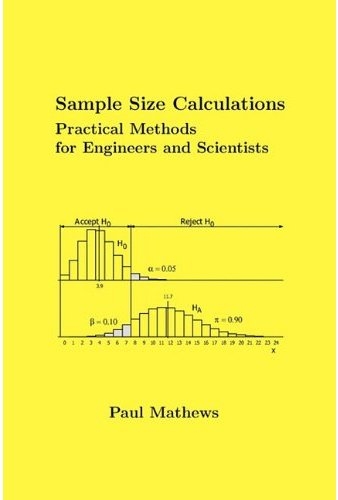
and Scientists Paul Mathews, Mathews Malnar and Bailey, Inc., 2010 ISBN 978-0-615-32461-6. Sample Size Calculations: Practical Methods for Engineers and Scientists presents power and sample size calculations for common statistical analyses including methods for means, standard deviations, proportions, counts, regression, correlation, and measures of agreement. Topics of special interest to quality engineering professionals include designed experiments, reliability studies, statistical process control, acceptance sampling, process capability analysis, statistical tolerancing, and gage error studies. The book emphasizes approximate methods but exact methods are presented when the approximate methods fail. Monte Carlo and bootstrap methods are introduced for situations that don't satisfy the assumptions of the analytical methods. Solutions are presented for more than 170 example problems. Solutions for selected example problems using PASS, MINITAB, Piface, and R are posted on the Internet.
|
 |